The future of artificial intelligence

Alan Turing’s pioneering work laid the foundation for artificial intelligence. Over the following decades, advancements in neural networks and deep learning paved the way for major breakthroughs in natural language processing, image generation, and medicine.
Today, the spotlight is on multimodal AI, which can process different types of data simultaneously. We are seeing rapid growth in compact, energy-efficient models, while large language models (LLMs) have become staple digital assistants.
Nations worldwide are already implementing national AI strategies. AI is expected to significantly boost the global economy, making human-technology collaboration more seamless and efficient than ever.
How artificial intelligence will evolve over the next decade
Artificial intelligence is set to become a seamless part of daily life. Its evolution will follow two parallel paths: on one hand, powerful open-source models like Meta’s Llama 3.1 and Mistral Large 2, and on the other, highly efficient, lightweight models like GPT-4o mini. The latter will run directly on personal devices, drastically lowering the cost of AI adoption.
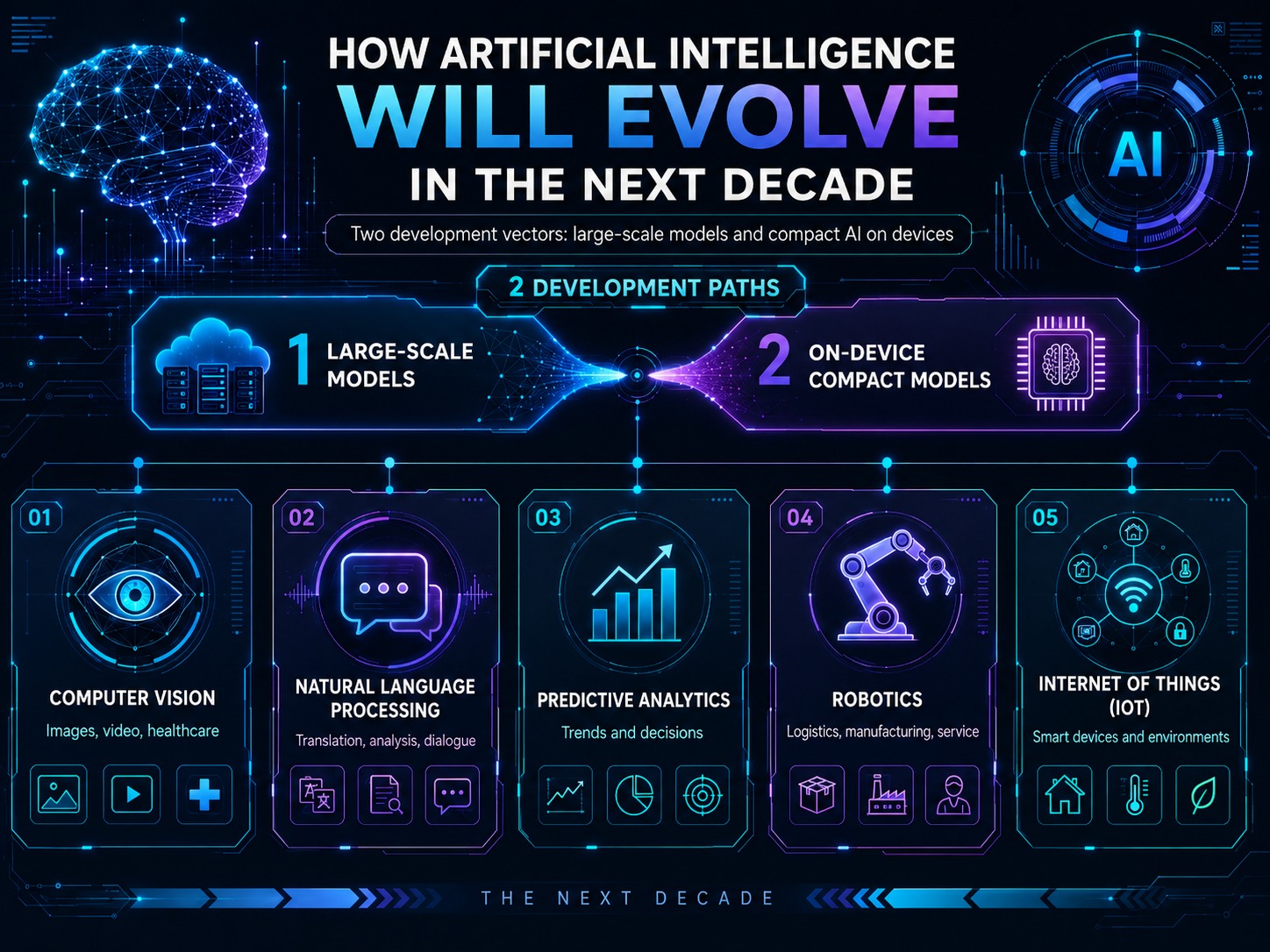
The most significant advancements are expected in the following areas:
- Computer vision – Advancements in image and video analysis for autonomous vehicles, healthcare, and industrial applications.
- Natural language processing (NLP) – Improved translation quality, sentiment analysis, and conversational systems.
- Predictive analytics – More accurate trend forecasting and decision-support systems.
- Robotics – The development of autonomous machines for logistics, manufacturing, and service industries.
- Internet of things (IoT) – Connecting smart devices into a unified, adaptive infrastructure.
Key directions of AI development
Here are the core trends and technological pathways that will shape the future of artificial intelligence in the coming years.
1. Multimodality will become the standard
Niche, single-format models will gradually give way to multimodal systems. These advanced models can simultaneously interpret text, speech, images, facial expressions, and tone of voice, responding with text, audio, images, or video.
2. The democratization of AI
Low-code and no-code platforms will enable non-technical users to build their own AI-driven solutions. Businesses will integrate AI via modular APIs, while automated machine learning (AutoML) will drastically simplify model fine-tuning.
3. Insurance for AI-related risks
Industries like finance, healthcare, and law will likely see the rise of specialized insurance products. These policies will cover financial and reputational damages caused by AI errors, including “hallucinations.”
4. AI in the c-suite
Artificial intelligence will become a critical tool for executive decision-making, helping leadership with financial planning, risk assessment, market analysis, and real-time scenario modeling.
5. Quantum AI
The rise of quantum computing will supercharge processing speeds for highly complex calculations needed in climate modeling, molecular biology, logistics, and other resource-intensive fields.
6. Beyond binary: ternary computing
In the future, AI hardware may transition to ternary logic — using three states instead of two. This paradigm shift could drastically reduce energy consumption and boost the efficiency of on-device processing.
7. Global regulation and ethical standards
As frameworks like the European Union’s AI Act become more widespread, countries will classify AI systems by risk level, enforce safety standards, restrict biometric surveillance in public spaces, and mandate human oversight for high-stakes decisions.
8. Agentic AI
Single, all-purpose models will make way for networks of specialized AI agents, each built for a specific task. Inquiries will be routed automatically to the most qualified agent, streamlining operations and improving accuracy.
9. Synthetic data and data governance
With high-quality human data in increasingly short supply, developers will rely heavily on synthetic data to train new models. This shift will elevate the importance of robust data governance to protect privacy and prevent “shadow AI” in the workplace.
10. Next-Generation Hardware
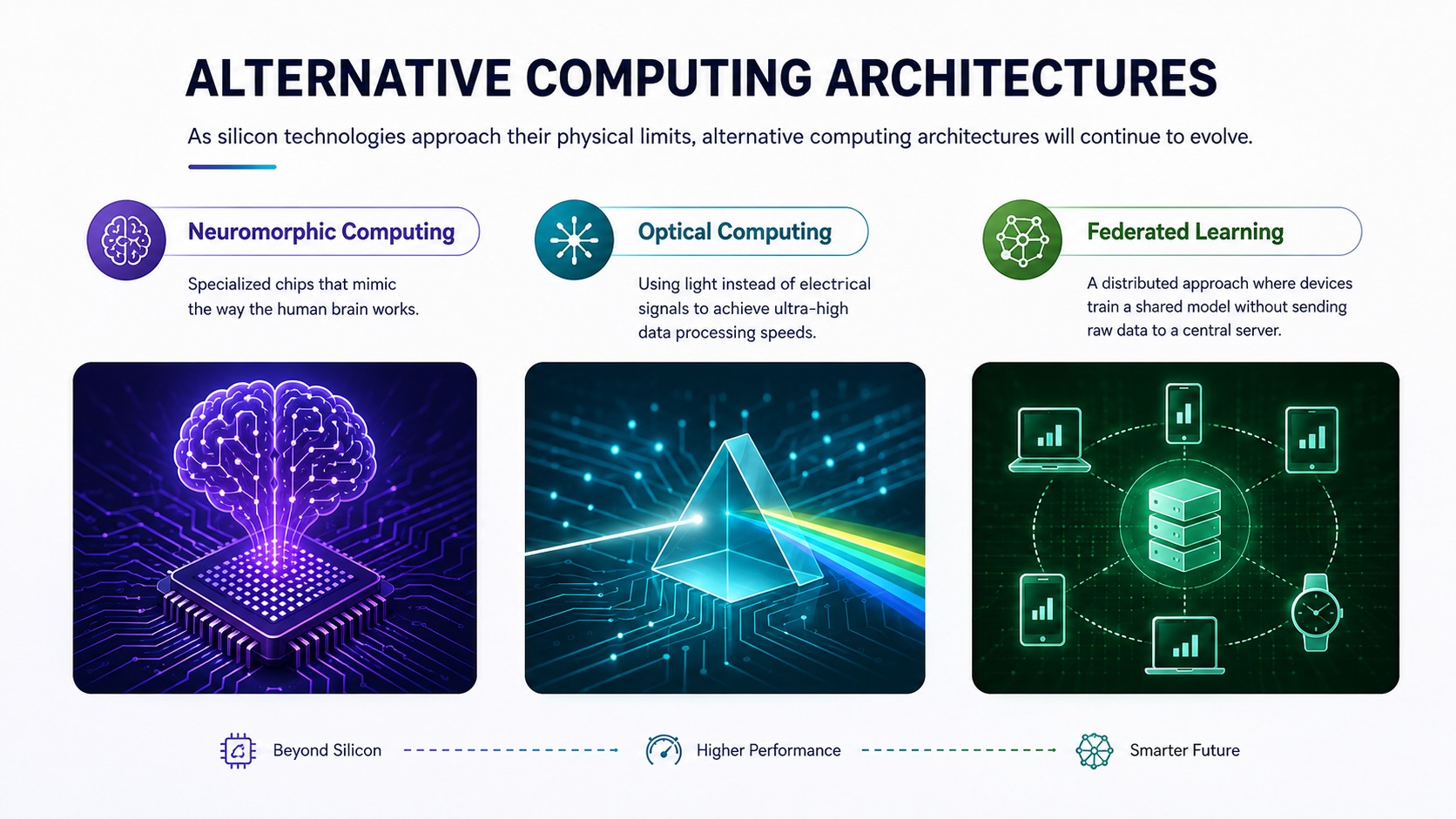
As silicon-based chips approach their physical limits, alternative hardware architectures will take center stage:
- Neuromorphic computing – Specialized chips designed to mimic the neural structure of the human brain.
- Optical computing – Using light instead of electricity to process data at ultra-high speeds.
- Federated learning – A decentralized approach where edge devices collaboratively train a shared model without sending raw data to a central server.