Information technology data processing
As industries evolve, 65% of companies believe they risk losing their competitive edge without leveraging big data. However, to get real value, simply collecting data isn’t enough — it must be prepared, structured, and formatted for practical use.
This is why businesses are increasingly adopting information technologies for data processing. They help automate routine tasks, speed up insights, increase calculation accuracy, and simplify managing massive datasets. While data visualization tools are widely used, there are various ways to structure the computing process, each solving a specific set of challenges.
Modern data processing technologies: 5 main methods
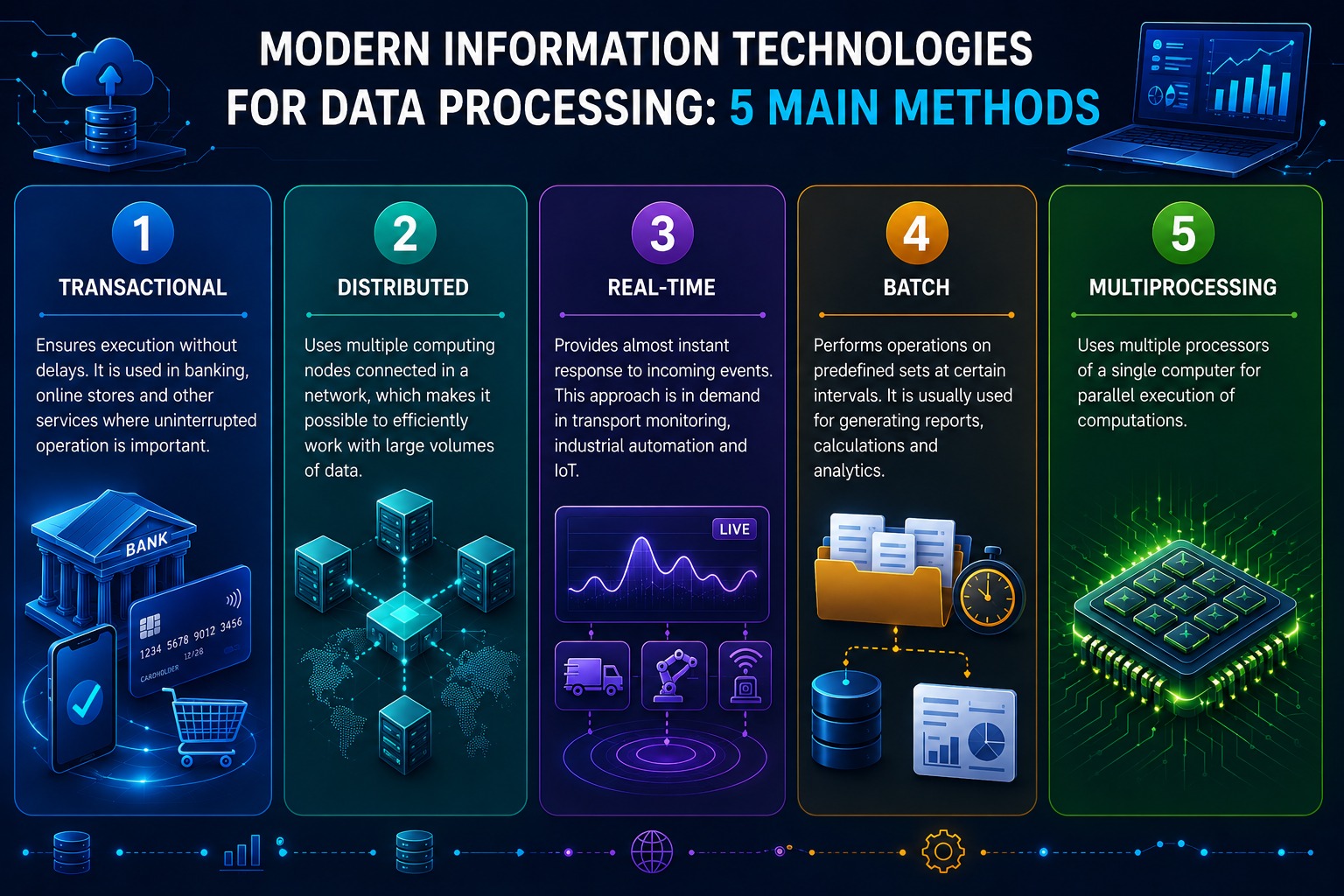
- Transactional – ensures zero-delay execution. Used in banking, e-commerce, and other services where continuous uptime is critical.
- Distributed – leverages multiple networked computing nodes, allowing for efficient processing of large datasets.
- Real-time – provides near-instantaneous response to incoming events. This approach is highly sought after in fleet tracking, industrial automation, and IoT.
- Batch – runs scheduled operations on pre-collected datasets at specific intervals. It is typically used for report generation, payroll, and analytics.
- Multiprocessing – uses multiple processors within a single computer to perform calculations in parallel.
Why choosing the right method matters?
The chosen approach directly impacts service performance, stability, and infrastructure scalability. For example, a stock exchange cannot function without transactional processing, as even minor delays can lead to massive financial losses.
It is also important to distinguish between the process itself and the tools used to implement it.
Data processing refers to converting raw information into a format that is easy for humans or software systems to use.
A data processing system is a software and hardware suite that implements the chosen method of handling information. This distinction makes it easier to understand the true purpose of data processing technologies: they automate tasks, reduce time-to-insight, support decision-making, secure data storage, and streamline business processes.
The right platform not only boosts company efficiency but also helps maintain compliance with regulatory standards, including GDPR and CCPA.
1. Transactional
This method is designed to log individual operations, such as bank transfers, purchases, bookings, and other user actions. Its main feature is high fault tolerance, achieved through hardware redundancy, service duplication, and rapid disaster recovery mechanisms.

2. Distributed
Computing workloads are distributed across multiple servers connected within a single infrastructure. This boosts performance and ensures continuous operation even if individual nodes fail. For instance, the HDFS file system automatically redistributes workloads among the remaining active servers. An additional benefit is the ability to move away from expensive mainframes.
3. Real-time
This approach enables near-instantaneous responses to changes. It is used where speed is critical: GPS tracking, video surveillance, the Internet of Things (IoT), financial services, and user activity tracking platforms. Unlike transactional processing, the top priority here is minimizing latency.
4. Batch
Data is accumulated over time before a single processing cycle is triggered. This model is ideal for generating reports, payroll calculations, compiling statistics, and other tasks where the completeness of the results is more important than real-time execution.
5. Multiprocessing
Calculations are performed simultaneously by multiple processors within a single computer, sharing the same hardware resources. Unlike distributed architecture, this approach does not rely on network communication between different machines. It is often favored by organizations handling highly confidential data, as all information remains within the local infrastructure.